Wednesday, January 19, 2011
Arvo Pärt & the musical connection between body & soul
Arvo Pärt talks about the musical connections between body and soul as the instrument of composers here. He rarely gives interviews so this is worth hearing. Last year he was 75. He says, "When everything is chaos, there's no meaning to life." He speaks about the evolution of his musical compositions in the creation of the Arvo Part Centre in Estonia. In earlier compositions, including his experience of singing Gregorian chant and the first and second symphonies, he says his heart had yet to be changed. In a conversation with a street cleaner about what music is, he heard the opinion that a musician must love every note, every tone. This became his goal.

Tuesday, January 18, 2011
Herod the Great?
Geza Vermes has a good article about reappraising Herod as in Great or Terrible. He summarizes:
I find Peter Richardson's book on Herod still the best.
This sketchy portrait reveals that Herod was a split personality in whom the two extremes of evil and good met. Josephus hit the nail on the head when he wrote:
How did this duality emerge?When we have regard to his...benefactions that he had made to mankind in general, even his detractors would be forced to admit the remarkable generosity of his nature. Yet when we consider his unjustified and vengeful treatment of his subjects and his closest relatives, and observe the unrelenting harshness of his character, we must regard him as a brute.
Josephus thought that the conflicting propensities arose from a single source and had a single motivation. Herod always endeavoured to please because he wanted to be admired by everyone. Josephus wrote:
His overriding aim was to glorify himself, and his ambition was to leave to posterity ever more imposing monuments of his reign; and this was the spur that drove him to build cities and lavish such enormous expense on the work.Herod loved honour, and was dominated by that passion, and his magnanimity revealed itself wherever there was hope of a lasting memorial or of immediate fame.
I find Peter Richardson's book on Herod still the best.
Saturday, January 15, 2011
Jesus & Wikipedia
Chris Wilson writes for Slate of Wikipedia's article on Jesus as a way of tracing the evolution of Wikipedia, now 10 years on. For example, first Jesus was "a central figure" in Christianity. Then Jesus became "the central figure" but "the most central figure" was a description that did not last long. Now Jesus is simply "central." Nothing in Wikipedia is static. Claye Shirky in the Guardian writes that Wikipedia is about activity prompted by caring rather than product. Of course all that activity has to be monitored and protected otherwise it would be overrun by spam and vandals. So behind the activity is the activity of guardian aka editors. We can trace the constant evolution of information/knowledge in Wikipedia's Jesus article in this link:
| Page title: | Jesus |
| Total revisions: | 22,801 |
| Number of minor edits: | 6,469 (28.37%) |
| Number of IP edits: | 4,686 (20.55%) |
| First edit: | 03 March 2001, 09:09:23 (by JimboWales) |
| Most recent edit: | 13 January 2011, 18:10:34 |
| Average time between edits: | 0.16 days |
| Average number of edits per month: | 192.49 |
| Average number of edits per year: | 2,309.84 |
| Number of edits in the last day: | 0 |
| Number of edits in the last week: | 5 |
| Number of edits in the last month: | 116 |
| Number of edits in the last year: | 1,128 |
| Number of users: | 6,137 |
| Average edits per user: | 3.72 |
| Number of edits made by the top 10% of active users: | 14,232 (62.42%) |
Thursday, January 13, 2011
Thoughtful Gardening by Robin Lane Fox
Looking out on my Mother's garden before leaving the UK, my thoughts are on gardening and the Spring. The day before yesterday, the stonemason put the headstone in place at my father's grave. We went back to see it in the rain and wind at the cemetery yesterday morning. Yesterday afternoon the lawnmower came back from its sojourn in the repair shop and along with it the shears for the flower bed edges. Today is warmer and the stillness of Winter seems past. The robins and the thrushes are eating seed and apples in the bird feeder enthusiastically. Or so it seems.
Robin Lane Fox, Professor of Ancient History, has written a book, Thoughtful Gardening in which he writes many useful and wise things. Jennifer Potter reviews the book in the TLS:
For Lane Fox, thoughtful gardening leads not to saving the planet but to knowledge, “an asset which is intertwined with gardening’s roots”. Thoughtful gardeners think before choosing and planting, visit gardens in distant places, and reflect on flowers in fiction and poetry. Far from aping wild nature, they practise their artifices in a “conscious, independent way”, free of moral purpose, cutting corners where they can, but neither expecting nor wanting instant gardens. They hate hanging baskets designed to jolly up town centres, and relish getting their hands dirty. But they still make mistakes. Having gardened since the age of ten, Lane Fox is proud to have steadily extended the range of plants he has “known, grown and killed personally”.
These are helpful notions to harbor at a time of farewells.
Robin Lane Fox, Professor of Ancient History, has written a book, Thoughtful Gardening
in which he writes many useful and wise things. Jennifer Potter reviews the book in the TLS:For Lane Fox, thoughtful gardening leads not to saving the planet but to knowledge, “an asset which is intertwined with gardening’s roots”. Thoughtful gardeners think before choosing and planting, visit gardens in distant places, and reflect on flowers in fiction and poetry. Far from aping wild nature, they practise their artifices in a “conscious, independent way”, free of moral purpose, cutting corners where they can, but neither expecting nor wanting instant gardens. They hate hanging baskets designed to jolly up town centres, and relish getting their hands dirty. But they still make mistakes. Having gardened since the age of ten, Lane Fox is proud to have steadily extended the range of plants he has “known, grown and killed personally”.
These are helpful notions to harbor at a time of farewells.
Wednesday, January 12, 2011
 The Warden by Anthony Trollope
Mr Harding, the Warden, is the main character. By the end of the book he is no longer the Warden. Whether he is guilty of misuse of Hiram's Trust funds for the maintenance of the almshouse and its elderly residents of which he is the Warden, neither he nor the reader knows. There does seem to be a discrepancy between the 800 pound income of the Warden and the meagre allowance given to the residents.
The Warden cannot bear the shame and public scrutiny of the investigation of the use of the trust funds brought about by Mr Bold, a local doctor who loves and who is loved by his daughter Eleanor. And Mr Harding is a quiet man given to simple pleasures. So at the very point that Mr Bold has been persuaded by Eleanor to drop the suit, he resigns as Warden in favour of a simpler, poorer life-style.
Because the warden is not a strong personality, his life is taken over by that of others. Yet he knows he needs to resign for peace of mind and to withstand the press. In the moment of crisis we are told nothing of his spiritual life and so conclude that it does not bear on his misfortune. When others tell him that the resignation he proposes will adversely affect his daughter's prospects, he thinks of the imagery of a pelican feeding its young with drops of its own blood. To my mind this is an indication of his ineffectiveness. All his life others have taken care of his professional opportunities and after the resignation the Bishop finds him another living.
The book shows how pursuit of justice can be blind. It indicates how things set in motion can take on a life of their own and how little control we might have of what start out to be good intentions. It is about impetuous youth and the villainy of the press and pamphleteers. It is about moral ambiguity and ecclesiastical privilege.
View all my reviews
Tuesday, January 11, 2011
2011, the 400th Anniversary of the King James' Bible Translation
There'll be plenty of occasions this year to commemorate in various ways the 400th anniversary of the King James translation of the Bible in 1611. Here's another. Another recent piece in the New York Times by Verlyn Klinkenborg speaks of the "impossibly learned team of men" producing the translation between 1604 and 1611. Not quite sure how to take that adverb "impossibly." But I agree that the legacy of the KJV and Tyndale is worth celebrating. I intend to do so all year.
Adrian Hamilton in the Independent however, reviews a British Library exhibit "One Language Many Voices" (until April 2011) that makes the point that English has evolved out of its flexible, syncretistic character while giving scarcely a nod to the KJV.
The question inevitably posed by the end of the show is where next in the age of the internet and globalised use of a language. English, as David Crystal – the presiding voice throughout the show – points out is spoken by two billion people today, only 400 million of which are native speakers? In other words, its use is by far and away dominated by those adopting it as a second or third language.
Sunday, January 09, 2011
Fay Godwin has left a legacy of remarkable photographs. Margaret Drabble writes movingly of her work in the Guardian. She says:
Since her death in 2005, photographers have been finding their access to both public and private land more and more problematic, more expensive, and legally restricted. In Our Forbidden Land she wrote about the dilemma of access to Stonehenge, a site mass marketed by English Heritage which charges substantial sums to everybody, from individual artists to wealthy advertising companies. She foresaw a time when "the only photographs we are likely to see of the inner circles of Stonehenge will be those approved by English Heritage, generally by their anonymous public relations photographers". Our common land would be the copyright of others. We are fortunate that she made her journeys round the British Isles when she did, before even more of our landscape was fenced off or built up.
An exhibit of her work is currently at The National Media Museum in Bradford until March 2011.
Friday, January 07, 2011
"Skin of your teeth" "Apple of your eye"--Legacy of the King James' Bible
A programme from BBC's Radio 4 assesses the legacy of the King James' translation of the Bible with various people. It notices the influence of Handel's Messiah as a conduit for the language of the King James' Bible.
Thursday, January 06, 2011
Hippodrome in Istanbul

The Serpent column as it is now known (see picture I took today from the entrance of the adjacent Turkish and Islamic Arts Museum) was moved from the Temple of Apollo at Delphi to the Hippodrome. The top was adorned with a golden bowl supported by three serpent heads. The bowl was destroyed or stolen during the Fourth Crusade. The serpent heads were destroyed as late as the end of the 17th Century.
 |
| Blue Mosque with obelisk in foreground |
Wednesday, January 05, 2011
Monday, January 03, 2011
Istanbul in the rain

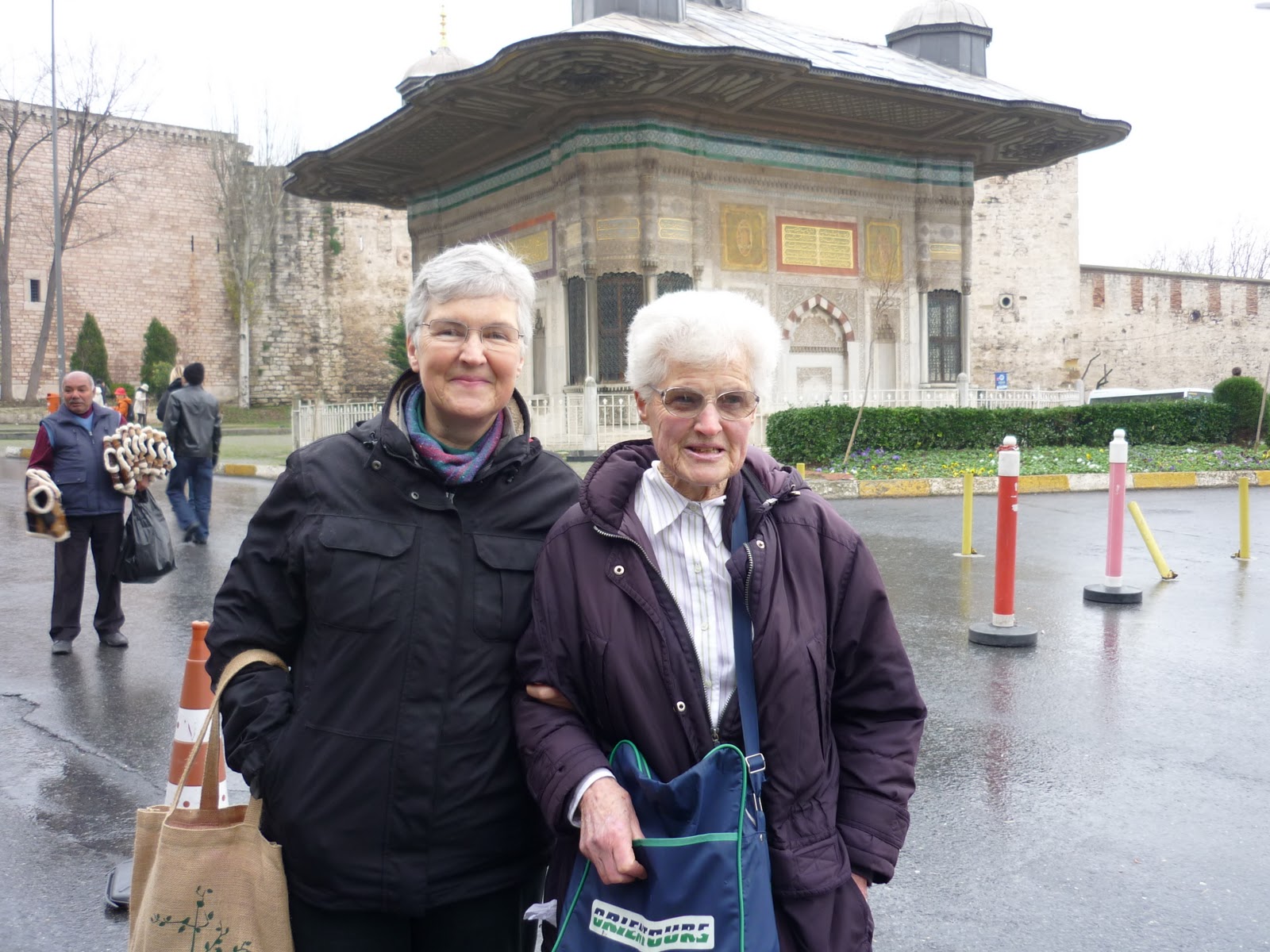
 (As I write, the Imam is chanting the call to prayer outside our window). And while conditions are damp, our spirits are not. Top Kapi palace was crowded but the collection of religious artifacts were particularly well attended. My favorite: Abraham's saucepan. I'm sure he used it often. It was portable of course (see my latest essay on mobile hospitality in Joanne McWilliam's festschrift). We also noted the Prophet's footprint, parts of John the Baptist and clothes and prayer mat of Fatima.
 And I must just observe that while a tour of the harem in the Top Kapi palace shows lovely blue tiles and striking bathroom features, it is depressing to imagine countless women who lived and died in the long dank marginal corridors and cold rooms.
We had turkish coffee (yes with almond schnapps) later that afternoon in the Grand Bazaar only to ward off the cold of course. And that little dish on the left contains lokum, namely turkish delight. There are endless varieties. Friends say that rose flavored is the best. The Grand Bazaar is a place where you receive more attention than you have hitherto received in your life. "I see no carpet that you are carrying," cried a carpet merchant to my Mother. "This is not good!"
Everyone should visit Istanbul one day. Next best thing is this book. True, there may be a little too much of what Brazilians call saudadje, but it is worth reading for a flavour of the city.
Subscribe to:
Posts (Atom)
The Oxford Handbook of the Book of Common Prayer Edited by Ruth A. Meyers, Luiz Carlos Teixeira Coelho, and Paul F. Bradshaw Oxford Handbo...
