Wednesday, February 20, 2013

Sunday, February 17, 2013
Scholarship to support work that makes the church safe for ALL
Scholarship & Grant Programs
THE LOUIE CREW SCHOLARSHIP
In recognition of Dr. Louie Crew’s many years of prophetic witness in and beyond the Diocese, The OASIS – a justice ministry of the Episcopal Diocese of Newark – is pleased to announce a fund to support scholarly work that shares our mission “to make the church safe for ALL people, and to challenge the church when its interest is self-preservation and not prophetic witness.”
The OASIS will award up to two annual scholarships of $2,500. Scholarship applications will be vetted by a special Scholarship Committee which will include Dr. Crew and winners will be announced at our anniversary event in June.
We welcome applications from writers, students, and researchers. To apply:
- Describe specifically in no more than 500 words how you will use the money to support ongoing scholarly work which shares the Oasis'
mission "to make the church safe for ALL people, and to challenge the church when its interest is self-preservation and not prophetic witness." - At the top of the sheet include your name and contact information.
- Attach a résumé no longer than one sheet.
- On a third sheet, provide a name, postal address, phone number and any
electronic address for two references who know you and your scholarship.
THE OASIS GRANT
We will also entertain applications for grants for specific projects within a congregation or ministry which are in keeping with our mission and goals. To be considered please supply the following information.
- What is the purpose of the grant?
- How will the grant be used that’s aligned with The Oasis’ mission?
- What’s the expected outcome as a result of the grant?
Please answer in as much detail as necessary and send your application to us at the contact below. Please note that if a grant is awarded a full accounting of the expenditure will be required.
HOW TO APPLY
The application period for 2012 has already concluded. If you would like to be considered for next year's awards, please apply by April 1st, 2013.
Submit your application to by April 1, 2013 to:
The Oasis
c/o A.S.P.
611 Union Boulevard
Totowa, NJ 07512
or chair@oasisnewark.org
The Oasis
c/o A.S.P.
611 Union Boulevard
Totowa, NJ 07512
or chair@oasisnewark.org
Sunday, February 10, 2013
Limitations of an Atheist perspective
Douglas Murray has a good piece in the Spectator about the limitations of atheism which he wrote as an accompaniment to a debate at Cambridge Union with the former ABC, Rowan Williams, Richard Dawkins, and Tariq Ramadan, ‘This House believes religion should have no place in the 21st century’ :
The more I listened to Dawkins and his colleagues, the more the nature of what has gone wrong with their argument seemed clear. Religion was portrayed as a force of unremitting awfulness, a poisoned root from which no good fruit could grow. It seems to me the work not of a thinker but of any balanced observer to notice that this is not the case. In their insistence to the contrary, a new — if mercifully non-violent — dogma has emerged. And the argument has stalled.
These new atheists remain incapable of getting beyond the question, ‘Is it true?’ They assume that by ‘true’ we agree them to mean ‘literally true’. They also assume that if the answer is ‘no’, then that closes everything. But it does not. Just because something is not literally true does not mean that there is no truth, or worth, in it.
Religion, whether you believe it to be literally true or not, provided people, and provides people still, with a place to ask questions we must ask. Why are we here? How should we live? How can we be good? Atheists often argue that these questions can be equally answered by reading poetry or studying philosophy. Perhaps, but how many people who would once have gathered in a place of worship now meet on philosophy courses? Oughtn’t poetry books to be selling by the millions by now?
We do not have many vessels for truth-carrying in our age.
Saturday, February 02, 2013
Accordance Seminars March 2&4 in NJ and PA
Here's a link to Accordance Training seminars in March 2013 in NJ and PA in case anyone is interested. Here's some information:
The seminars are scheduled for 9 A.M. to 6 P.M. and will consist of three sessions with a break for lunch. The schedules are subject to some adjustments. If you plan to skip the first session, be sure that you are familiar with the Accordance interface and basic searching. The online Podcastsoffer helpful preparation. 9:00 - 12:00: Accordance interface: Toolbar, Library, Searching, and Amplifying. 1:15 - 2:30: Map, Timeline and Images, User Tools and Notes, iOS. 2:45 - 6:00: Greek and Hebrew, Constructs, Advanced Searches and Wildcards. We recommend you bring a computer loaded with Accordance so that you can follow along, but it is not essential. The training program will be projected. We highly recommend that you purchase a copy of the newly released Seminar Training Manual if you do not already own one. This manual will be referred to throughout the seminar. We will have them available for purchase at the seminar, but you may purchase one in advance for pick up at the seminar if you wish. Just order online and and mark the order for manual processing with a note that you want to pick this up at the seminar so our staff can adjust the order to remove the shipping charges before completing it for you. Be sure to upgrade to our NEWLY RELEASED Accordance 10before attending the seminar, as this will be the version the instructor teaches from. Having version 10 up and running will make it much easier to follow along throughout the seminar. You can upgrade now by purchasing the Accordance 10 Starter Collection. Most people who take the time to come are extremely grateful to learn all the things that they never knew they were missing. Please share this seminar information with the staff and students at any institution in the area, as well as to any users you know. |
 |
Tuesday, January 22, 2013
Talk on January 26th, 2013
St. John’s Episcopal Church
12 Prospect Street Huntington NY 11743 (www.stjohnshuntington.org)
Saturday, January 26th, 2013 10am -1pm (Light lunch will be provided)
Communities Around Jesus: Disciples, Apostles and other Followers in Early Christianity
Using Paul's letters and parts of the gospels, we will discuss emerging communities of disciples of women and men who were followers of Jesus in cities and communities of Asia Minor, Syria, Rome and Jerusalem.
Dr. Deirdre Good is professor of New Testament at The General Theological Seminary, specializing in the Synoptic Gospels, Christian Origins, noncanonical writings and biblical languages (Greek and Coptic). An American citizen, she grew up in Kenya and keeps the blog On Not Being a Sausage (notbeingasausage.blogspot.com). She has written books on Matthew's portrait of Jesus (Jesus the Meek King, 1999), on Mary traditions in Judaism, Christianity and Islam (Mariam, the Magdalen and the Mother, 2005), on households and family in the time of Jesus (Jesus' Family Values, 2006) and most recently, Reading the New Testament, A Fortress Introduction with Bruce Chilton (2010). She also blogs for Episcopal Cafe.
Contact Heather Kress hkress@optonline.net Church: 631-427-1752
Suggested donation: $10.00
Sponsored by St. John’s Women’s Spirituality Group
Thursday, December 27, 2012
Mithras & Mithraism
In Our Time has a discussion of Mithraism this week led by Melvin Bragg with Greg Wolf of the University of St. Andrews; Almut Hintze, of the School of Oriental and African Studies, and John North, Acting Director of the Institute of Classical Studies at the University of London.
The first Mithreae occur on the banks of the Danube in the first century CE perhaps connected with the port Ostia. Extending from Hadrian's Wall to the Black Sea, the cult of Mithras offered a sense of help and salvation (perhaps in another life). We see it from the outside so it is had to reconstruct.
An Indo-Iranean god Mithra dates back to 1300BCE from the ANE mentioned in a contract with four deities to whom a king swears to keep a contract. There is a hymn to Mithra in which Mithra is invoked as an object of worship.
In the 70's, scholars challenged a connection between Zoroastrian ideas and Mithraism (posited by Franz Cumont), arguing instead that western Roman accounts e.g. by Porphyry should be examined in their own right. However, the argument of Cumont persists here. Although we have no first person singular accounts, in accounts of Mithraic mysteries and in Mithraea, an important act depicted is the slaughter of a bull.
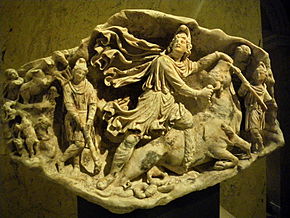
We know a little about the initiation through seven stages of initiation indicated through revelation, perhaps connected to the seven planets. Men start as a raven and work their way up to the level of "Father" but perhaps few people made it through all seven. Here are some examples of Mithraea today (the picture is one I took of the Mithraeum in Walbrook, London in 2009).

The first Mithreae occur on the banks of the Danube in the first century CE perhaps connected with the port Ostia. Extending from Hadrian's Wall to the Black Sea, the cult of Mithras offered a sense of help and salvation (perhaps in another life). We see it from the outside so it is had to reconstruct.
An Indo-Iranean god Mithra dates back to 1300BCE from the ANE mentioned in a contract with four deities to whom a king swears to keep a contract. There is a hymn to Mithra in which Mithra is invoked as an object of worship.
In the 70's, scholars challenged a connection between Zoroastrian ideas and Mithraism (posited by Franz Cumont), arguing instead that western Roman accounts e.g. by Porphyry should be examined in their own right. However, the argument of Cumont persists here. Although we have no first person singular accounts, in accounts of Mithraic mysteries and in Mithraea, an important act depicted is the slaughter of a bull.
We know a little about the initiation through seven stages of initiation indicated through revelation, perhaps connected to the seven planets. Men start as a raven and work their way up to the level of "Father" but perhaps few people made it through all seven. Here are some examples of Mithraea today (the picture is one I took of the Mithraeum in Walbrook, London in 2009).

Friday, December 14, 2012
Beauvoir and Beyond: March 2013
Beauvoir and Beyond: Philosophy and Sexual DifferenceAbby Kluchin
Barnard Center for Research on Women, 101 Barnard Hall in Manhattan

(Presented in collaboration with the Barnard Center for Research on Women)
“But if I wish to define myself,” Simone de Beauvoir writes, “I must first of all say: ‘I am a woman’; on this truth must be based all further discussion.” With this declaration—and the publication of The Second Sex in 1953—the question of “woman” becomes a proper topic of philosophical investigation, as Beauvoir demystifies the “eternal feminine” and lays bare the relationship of “masculine” and “feminine” and how they function to construct woman as Other. In the wake of Beauvoir, other feminist thinkers take up many of her questions, but abandon her existentialist presuppositions. In this course, we will examine a set of twentieth century texts that insist on taking woman, gender, and sexual difference seriously. The first half of the course will center around readings from the new unabridged English edition of The Second Sex, in conjunction with relevant primary and secondary literature, including the work of Jean-Paul Sartre and selections from Toril Moi’s Simone de Beauvoir: the Making of an Intellectual Woman. The second half of the course will consider so-called “French feminism” after Beauvoir, a designation that includes figures as diverse as Julia Kristeva, Luce Irigaray, Hélène Cixous, Monique Wittig, and Michèle le Doueff. These thinkers diverge in a variety of ways from Beauvoir’s approach. But they continue to insist on the necessity of confronting the question of sexual difference, as well as the theorization and performance of distinctly feminine writing that they term écriture feminine or parler-femme.
Held Thursdays, 7pm
Starts March 7, 2013
Lasts
Costs $315
Starts March 7, 2013
Lasts
Costs $315
Monday, November 26, 2012
Condensed Bible(s)
 This advertisement appeared in Sunday's NY Times book review (and in many other places I'm sure). Roy Peter Clarke explains the origin of the project:
Gene Patterson, an extraordinary writer and editor, decided to undertake one final, audacious act. On a laptop from his sickbed, he created a streamlined version of the King James Bible. It turns out that even Moses needed an editor.
The Old Testament was just too long, concluded this famous son of the South, too discursive, too beside the point. There were great stories in the Bible, some of the greatest ever told. But it was too hard to get at them and to see the connections. It was as if the human authors of Scriptures, however inspired by God, had found a fertile meadow and planted a patch of kudzu.
"A lot of people want to come in the house," Patterson said of potential readers and believers, "but they can't get up the steps."
Now Gene Patterson has done some extraordinary things with words in his life. He was a columnist and editor for the Atlanta Constitution in the 60's at a time when newspapers hired writers who were also editors. he got up every day and wrote a column.
The influence of Patterson's columns became legendary. Written during the classic period of the Civil Rights movement, Gene worked to convince his fellow white Southerners that they were wrong on matters of race, and that the sky would not fall if they changed. His column in 1963 on the Birmingham church bombing, in which four little girls were murdered, was deemed so powerful that Walter Cronkite asked Gene to read it on the CBS Evening News.
"A Negro mother wept in the street Sunday morning in front of a Baptist Church in Birmingham," wrote Patterson. "In her hand she held a shoe, one shoe, from the foot of her dead child. We hold that shoe with her." Such work earned Patterson a Pulitzer Prize in 1967.
There are however are some problems with the new condensed edition. Roy Peter Clarke, friend and colleague of Gene Patterson indicates that the principles by which the editing and condensing was done are idiosyncratic.
Gone are the genealogies, histories, digressions and repetitions that blocked the flow of the narrative. His goal, he says, is to reveal the "thread," a story of salvation that could be read as a book.
The details of editing Scripture are messier and more problematic.
Let's take the Psalms. Psalm numbers 2, 5, 10, 12, 13, and 21 — all gone. Certainly the 23rd Psalm, which hangs on the wall of my bedroom in all its comforting glory, must have survived the knife? Not so. "Walk through the valley of the shadow of death" prevails, but not "thou preparest a table before me in the presence of mine enemies; thou anointest my head with oil." (In an earlier version, Patterson cut "My cup runneth over" — as if to say that nothing will runneth over in this edition — but restored the line in the end.)
In the past there have been other examples of condensed Bibles. But whether we agree or disagree with the work, and whether we have other issues with Bibles that are the result of committee work in previous generations, is editing by means of undisclosed principles the answer? I don't think so.
Friday, November 23, 2012
Wednesday, November 14, 2012
Tonight at UTS
The Deadly Link between Slavery and Environmental Destruction
A presentation by
Kevin Bales
Wednesday, November 14th
6:00 – 7:30 pm
James Chapel, Union Theological Seminary
121st Street and Broadway
All CSSR events are free and open to the public, but we ask that you please RSVP at our website: http://wordpress.ei.
Wednesday, November 07, 2012
Maine & Maryland approve same-sex marriage
"For the first time, voters in Maine and Maryland voted to allow loving couples to make lifelong commitments through marriage -- forever taking away the right-wing talking point that marriage equality couldn't win on the ballot," said Chad Griffin of the Human Rights Campaign, a national gay-rights group in a report from PBS.
In our town of Northport, 84.14% of registered voters actually voted - 950 souls out of 1,129. 55.51% voted yes on gay marriage. This is wonderful turnout and a great result!
In our town of Northport, 84.14% of registered voters actually voted - 950 souls out of 1,129. 55.51% voted yes on gay marriage. This is wonderful turnout and a great result!
Subscribe to:
Comments (Atom)
The Oxford Handbook of the Book of Common Prayer Edited by Ruth A. Meyers, Luiz Carlos Teixeira Coelho, and Paul F. Bradshaw Oxford Handbo...
