On Sunday I spoke at an IPC meeting on Jesus, Mary Magdalene, and the DaVinci Code at St. Francis Church on Staten Island. The discussion was reported in the press yesterday.
I'm thrilled to see from participants' comments in the article that my two-fold approach in the talk seems to have been successful. First, through a handout with expanded paragraphs from the Gospels of Philip and Mary describing the relationship of Jesus and MM, one can see what the implications of Dan Brown's shorter paragraph choices are. That doesn't mean that we need to abandon investigation of the relationship between Jesus and MM.
So I turned to a presentation and discussion of medieval typological depictions in the Biblia Pauperum of MM at the tomb in John 20 through the lens of the bride searching for and finding her lover in the Song of Songs. Its easier to look at illustrations from the Bible of the Poor than it is to read interpretations of MM at the tomb as the bride in the Song of Songs searching for and finding Jesus in writings of Cyprian or other church fathers. Besides, a picture speaks a thousand words.
No one seems to have found this discussion undermined their faith. And it enhances appreciation for questions raised by the DVC.
Tuesday, March 28, 2006

Saturday, March 25, 2006
A History of Slavery in New York
We went to the New York Historical Society exhibit, Slavery in New York
open until March 26th at the New York Historical Society.
From the 1600's to 1827, it reconstructs the slave trade and its impact first on the Dutch in New York, and then the British, arguing that as many as 20% of New Yorkers were enslaved African-Americans. During the colonial period, 41% of the city's households had slaves, compared to 6% in Philadelphia and 2% in Boston. Only Charleston, South Carolina, rivaled New York in the extent to which slavery penetrated everyday life. By 1775, in New York there were 3,100 slaves, accounting for 30 percent to 40 percent of the city's workforce. While the exhibit does not clarify this statistic, the website notes that each slaveholding New Yorker usually owned only one or two persons. Its also important to note slavery was less central to the economy and social order in New York than it was in Virginia or South Carolina (let alone Caribbean colonies such as Jamaica or Saint Domingue, where the vast majority of the population was enslaved). Thus, it was easier to abolish slavery in New York than it was in the South: in the wake of the American Revolution, every state north of Delaware initiated the abolition of slavery, whereas none of the Southern states did.
One other quibble: the introductory video included a quote from Aristotle about slavery being normative. But slavery in classical Greece was not at all the same thing as slavery in the New World. It would have been good to clarify different kinds of slavery.
The New York Times review notes that the exhibit tends to overlook this broader context. However, the exhibit is provocative, the information is new, and no one comes away unaffected.
We were able to hear the Abyssinian Baptist Church Sanctuary Choir (director Dr. Jewel T. Thompson) perform spirituals including "Rock my soul in the bosom of Abraham." For the first time I heard it as an interpretation of the Lucan parable of Lazarus and the rich man from the point of view of slaves. I'll never hear it in the same way again.
open until March 26th at the New York Historical Society.
From the 1600's to 1827, it reconstructs the slave trade and its impact first on the Dutch in New York, and then the British, arguing that as many as 20% of New Yorkers were enslaved African-Americans. During the colonial period, 41% of the city's households had slaves, compared to 6% in Philadelphia and 2% in Boston. Only Charleston, South Carolina, rivaled New York in the extent to which slavery penetrated everyday life. By 1775, in New York there were 3,100 slaves, accounting for 30 percent to 40 percent of the city's workforce. While the exhibit does not clarify this statistic, the website notes that each slaveholding New Yorker usually owned only one or two persons. Its also important to note slavery was less central to the economy and social order in New York than it was in Virginia or South Carolina (let alone Caribbean colonies such as Jamaica or Saint Domingue, where the vast majority of the population was enslaved). Thus, it was easier to abolish slavery in New York than it was in the South: in the wake of the American Revolution, every state north of Delaware initiated the abolition of slavery, whereas none of the Southern states did.
One other quibble: the introductory video included a quote from Aristotle about slavery being normative. But slavery in classical Greece was not at all the same thing as slavery in the New World. It would have been good to clarify different kinds of slavery.
The New York Times review notes that the exhibit tends to overlook this broader context. However, the exhibit is provocative, the information is new, and no one comes away unaffected.
We were able to hear the Abyssinian Baptist Church Sanctuary Choir (director Dr. Jewel T. Thompson) perform spirituals including "Rock my soul in the bosom of Abraham." For the first time I heard it as an interpretation of the Lucan parable of Lazarus and the rich man from the point of view of slaves. I'll never hear it in the same way again.
Sunday, March 19, 2006
Truth and Fiction
Now that closing statements for the copyright hearing in London are underway, it seems appropriate to note Dan Brown's own witness statement of Dec 21st, 2005. Paragraph 192, for example, makes it clear that the paragraphs from the Gospel of Philip and Mary cited in the DVC as (the only) ancient evidence for the marriage of MM and Jesus derive from secondary sources such as Elaine Pagels' book, The Gnostic Gospels.
Paragraph 217 clarifies that DVC as a novel is a work of fiction that uses verifiable material such as Da Vinci's paintings, the Gnostic Gospels and Hieros Gamos. These facts are interpreted by fictional characters in DVC in ideas that Brown believes have merit but the reader is encouraged to come up with opinions about religion and faith assessing the evidence for themselves.
An opinion piece by Viv Groskop in the Observer for March 19th makes the point that critics of Brown are having a field day since revelations of the trial like Brown's witness statement above make it fashionable to sneer at popular money-making novels. Groskop rightly notes that all this is beside the point. I agree and in public always say that anything that promotes discussion of ancient Christianity or ideas in the DVC such as recognizing male bias in ecclesiastical tradition is all to the good. No matter that DVC rests on our fascination with conspiracies. The timing of its phenomenal success has to do with, I believe, the scandal of pedophilia in the Roman Catholic Church that is far from over.
Religious leaders need, for example, to take note of widespread interest in the argument of DVC that the church has suppressed the feminine whether in ecclesiastical imagery, theology, or office holders. What is the evidence? How might it be interpreted? The argument of the Catholic League that Ron Howard should add a disclaimer at the beginning of the DaVinci Code that the movie is fictional rests on the notion that we faithful cannot think for ourselves. Religious leaders have yet another opportunity to discuss many issues the book raises including the sources of women's spiritual authority when the movie is released in May.
The paragraphs from the Gospels of Mary and Philip cited in the DVC need to be read in context of the gospels from which they derive. Not even gospel writers thought that Jesus' cursing of the fig tree (reported in Matthew and Mark and interpreted in Luke) had anything to do with a fit of pique. The notion of a kiss in the Gospel of Philip, for example, is that it is the means by which "the perfect" conceive and give birth. Perhaps this is the way initiates join a community of "perfect" in Philip: initiates come into being through the generating activity of that community whether by sacramental acts or other types of initiating rites. Any interpretation of a kiss in the Gospel of Philip must start with its notion of sacramental reality.
Of course its not easy to understand ancient texts like Philip and Mary especially since they stand outside a 2000 year old tradition of interpretation. But new editions and interpretations of these texts and others like them are published all the time!
Paragraph 217 clarifies that DVC as a novel is a work of fiction that uses verifiable material such as Da Vinci's paintings, the Gnostic Gospels and Hieros Gamos. These facts are interpreted by fictional characters in DVC in ideas that Brown believes have merit but the reader is encouraged to come up with opinions about religion and faith assessing the evidence for themselves.
An opinion piece by Viv Groskop in the Observer for March 19th makes the point that critics of Brown are having a field day since revelations of the trial like Brown's witness statement above make it fashionable to sneer at popular money-making novels. Groskop rightly notes that all this is beside the point. I agree and in public always say that anything that promotes discussion of ancient Christianity or ideas in the DVC such as recognizing male bias in ecclesiastical tradition is all to the good. No matter that DVC rests on our fascination with conspiracies. The timing of its phenomenal success has to do with, I believe, the scandal of pedophilia in the Roman Catholic Church that is far from over.
Religious leaders need, for example, to take note of widespread interest in the argument of DVC that the church has suppressed the feminine whether in ecclesiastical imagery, theology, or office holders. What is the evidence? How might it be interpreted? The argument of the Catholic League that Ron Howard should add a disclaimer at the beginning of the DaVinci Code that the movie is fictional rests on the notion that we faithful cannot think for ourselves. Religious leaders have yet another opportunity to discuss many issues the book raises including the sources of women's spiritual authority when the movie is released in May.
The paragraphs from the Gospels of Mary and Philip cited in the DVC need to be read in context of the gospels from which they derive. Not even gospel writers thought that Jesus' cursing of the fig tree (reported in Matthew and Mark and interpreted in Luke) had anything to do with a fit of pique. The notion of a kiss in the Gospel of Philip, for example, is that it is the means by which "the perfect" conceive and give birth. Perhaps this is the way initiates join a community of "perfect" in Philip: initiates come into being through the generating activity of that community whether by sacramental acts or other types of initiating rites. Any interpretation of a kiss in the Gospel of Philip must start with its notion of sacramental reality.
Of course its not easy to understand ancient texts like Philip and Mary especially since they stand outside a 2000 year old tradition of interpretation. But new editions and interpretations of these texts and others like them are published all the time!
Saturday, March 04, 2006
Women's History Month
March is Women's History Month! (Its also Colon Cancer Awareness Month but that's for another post). There's so much to celebrate and so much still to do....
Those of us who are well off might consider a donation to worthy causes. One of mine is news about women around the world including cheers and jeers of the week.
This month on March 21st at the seminary Prof. Amy-Jill Levine from Vanderbilt lectures on "Jesus and Judaism: the Connection Matters." From the point of view of historical accuracy, what could be more important? Amy-Jill is always lively and engaging so come along! Its free!
Other things to do:-
Joan Acocella in “The Saintly Sinner” reserves to the gospel of John the spiritual implications of Mary’s encounter with a gardener/resurrected Jesus. But Mary’s fragmentary vision of the ascent of the soul in the Gospel of Mary is woven of the same cloth: death, despair and weeping followed by revelation and commission. This vision clearly pertains to the “matters of the soul” Acocella prefers to attach to John. But the issue is not which text contains more spirituality. The issue is why Mary’s vision in John comes to represent gender conflict. This is not a Gnostic problem. There’s more to Mary Magdalene’s story than a pitch for the priesthood of women based on authority in matters of the soul; what’s at stake is the authenticity of all women’s religious vision, in every religious tradition.
Happy Women's History Month!
Those of us who are well off might consider a donation to worthy causes. One of mine is news about women around the world including cheers and jeers of the week.
This month on March 21st at the seminary Prof. Amy-Jill Levine from Vanderbilt lectures on "Jesus and Judaism: the Connection Matters." From the point of view of historical accuracy, what could be more important? Amy-Jill is always lively and engaging so come along! Its free!
Other things to do:-
- ask your local place of worship to hold an event featuring a woman speaker
- ask your local bookstore to feature women authors signing books
- ask your community center to host an event celebrating women in the local community
- write a letter to the editor of your local paper explaining why its important to mark this month
Joan Acocella in “The Saintly Sinner” reserves to the gospel of John the spiritual implications of Mary’s encounter with a gardener/resurrected Jesus. But Mary’s fragmentary vision of the ascent of the soul in the Gospel of Mary is woven of the same cloth: death, despair and weeping followed by revelation and commission. This vision clearly pertains to the “matters of the soul” Acocella prefers to attach to John. But the issue is not which text contains more spirituality. The issue is why Mary’s vision in John comes to represent gender conflict. This is not a Gnostic problem. There’s more to Mary Magdalene’s story than a pitch for the priesthood of women based on authority in matters of the soul; what’s at stake is the authenticity of all women’s religious vision, in every religious tradition.
Happy Women's History Month!
Saturday, February 25, 2006
Our Household

is more often than not rather furry. We live in seminary housing in the middle of Chelsea with our two dogs Diamond and Reuben, and our two cats Fishy and Mouflon. Reuben and Fishy get on well (as you see) but alas, the same cannot be said of Mouflon and Fish. Mouflon seems to think of himself as something other than a cat (a dog perhaps?) and prefers to relate to people.
Living in a household wherein only two occupants communicate by words makes one pay attention to NVC: canine gestures, movements, expressions; feline presence and sounds (Fishy is part siamese) all play a part of daily routine. Laura Hillenbrand describes Tom Smith, Seabiscuit's trainer: "Perhaps Smith spoke so infrequently because he was listening so hard. Horses speak with the smallest of motions; Smith saw and heard everything." When the grooms walked horses round in circles to cool them down, they'd see him "squatting on the floor turning the horses over in his mind." "He lived by a single maxim: Learn your horse. Each one is an individual, and once you penetrate his mind and heart, you can often work wonders with an otherwise intractable beast."
We got Reuben as an eight week old puppy. He was off leash on 10th Avenue following an older dog and a young man. Julian said to the young man, "If you love your dog, you'll keep him on a leash as 10th Avenue is very busy." When the young man announced that he wanted not to keep but to sell him, Julian said, "Done!" Reuben arrived in our house after a quick checkup at the local vet, and the first thing he did was rush to hide behind Angus, our old shepherd, who was lying down. Angus, being rather old and mellow, offered Reuben the puppy a safe warm vantage point from which to take in the lay of our apartment. Negotiating Diamond, our female shepherd (who is rather tempramental due to her unstable upbringing before we got her) and with whom he grew up as a sister/mother substitute, is one of Reuben's skills.
Wednesday, February 22, 2006
Whatever happened to imagination?
In an effort to revive sagging fortunes and declining attendance at Colonial Williamsburg, organizers at the Colonial Williamsburg Foundation have affianced themselves to an organization called "Revolutionary City" (Virginia Pilot, Feb 21st). Starting in March, parts of the town will be closed to tourists unless they pay extra admission fees. Behind the gates, "Revolutionary City" will recreate events during the American revolution between 1776-1783 in which "George Washington" will address the troops before the march to Yorktown, for example. Fee paying guests may ask a soldier what he thinks of his leader (Newsweek, Feb 13th).
Apparently, museum administrators opine that people today have a harder time connecting their own lives with living history sites like Williamsburg. They feel that recreations of distant events with live actors will help today's multicultural audiences do just that.
The Virginia Pilot article reports that in the mid-eighties 1.2 million paying visitors a year kept local restaurant and hotels busy. When I visited in 1976, it was thriving. I enjoyed every minute of my visit. So what happened to imagination? I don't know about you, but once I see a recreation of an event or a book as a movie, its likely that images from the movie replace what I once imagined as the battle of Culloden and the defeat of Bonnie Prince Charlie, or a tea farm in Kenya where Karen Blixen once lived at the foot of the Ngong hills (about which I know a tiny bit having grown up near Kisumu). Imagination not only liberates our minds and hearts but it creates possibility and vision. It is polyvalent and not uniform: no images need be set in stone.
Recently I revisited the Walters Art Gallery in Baltimore. My acoustiguide allowed me to access three kinds of information: descriptions of art works, assessments of the religious significance of various pieces and short pieces of music thought relevant to the piece. With imagination and emotions kindled, I can still see and hear a painting and accompanying music from that visit. If my critical imagination abandoned painting descriptions or thought another piece of music more suitable to a painting or sculpture, so much the better.
I've been to Gettysburg. The field where Pickett's charge took place and the setting for President Lincoln's Gettysburg address live in my imagination aided by a few photographs of the time. I am alas, sceptical that recreating events from the period of the American revolution will heighten my engagement with the period. I'm glad I went to Williamsburg a long time ago.
Apparently, museum administrators opine that people today have a harder time connecting their own lives with living history sites like Williamsburg. They feel that recreations of distant events with live actors will help today's multicultural audiences do just that.
The Virginia Pilot article reports that in the mid-eighties 1.2 million paying visitors a year kept local restaurant and hotels busy. When I visited in 1976, it was thriving. I enjoyed every minute of my visit. So what happened to imagination? I don't know about you, but once I see a recreation of an event or a book as a movie, its likely that images from the movie replace what I once imagined as the battle of Culloden and the defeat of Bonnie Prince Charlie, or a tea farm in Kenya where Karen Blixen once lived at the foot of the Ngong hills (about which I know a tiny bit having grown up near Kisumu). Imagination not only liberates our minds and hearts but it creates possibility and vision. It is polyvalent and not uniform: no images need be set in stone.
Recently I revisited the Walters Art Gallery in Baltimore. My acoustiguide allowed me to access three kinds of information: descriptions of art works, assessments of the religious significance of various pieces and short pieces of music thought relevant to the piece. With imagination and emotions kindled, I can still see and hear a painting and accompanying music from that visit. If my critical imagination abandoned painting descriptions or thought another piece of music more suitable to a painting or sculpture, so much the better.
I've been to Gettysburg. The field where Pickett's charge took place and the setting for President Lincoln's Gettysburg address live in my imagination aided by a few photographs of the time. I am alas, sceptical that recreating events from the period of the American revolution will heighten my engagement with the period. I'm glad I went to Williamsburg a long time ago.
Sunday, February 19, 2006
Professor R. McL. Wilson's 90th Birthday
Thirty years ago when I was an undergraduate at St. Mary's College, St. Andrews University in Scotland, Professors Ernest Best, Matthew Black and Robin McL. Wilson ran the NT department. My father took me to visit before I was accepted and anxiously inquired of Principal Black whether it was likely that I might marry a presbyterian. "Oh, there are many different groups represented here" was the reply.
Prof. Wilson once told us at St. Mary's a wonderful story about material being prepared for a two volume work on NT Apocrypha and Pseudepigrapha he translated into English. Some of the material was given to a typist who happened to be a friend of Prof. Nisbet's daughter. Prof. Nisbet recounted that his daughter came to him wondering (on behalf of her friend) about Prof. Wilson's interest in ghosties. "Oh, its not ghosties Prof. Wilson is interested in," he replied, "Its Gnostics."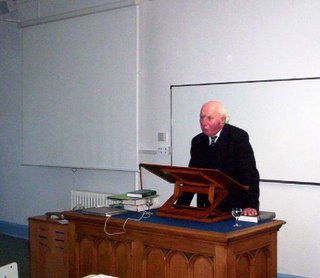
Yesterday was given over to a celebration of Prof. Wilson's 90th birthday as reported by Jim Davila in Paleojudaica (from whom I have appropriated this picture). It was through Prof. Wilson that I became interested in Gnosticism and it was thanks to him that I ended up studying with George Macrae at Harvard.
We last met in 2000 at the SNTS meeting in Durham (see below). Perhaps my favorite memory of him was from an academic meeting in Rome in 1974. He kindly took me under his wing as it was my first visit to "the eternal city." One afternoon, his hearing aid failed as we set out on a guided tour of the catacombs. He simply turned it off and enjoyed the tour with the rest of the group.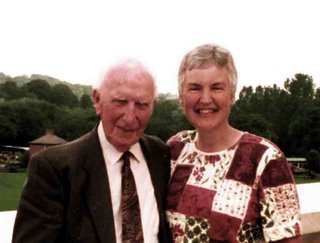
Here's to you, Robin! Lang may your lum reek!
Prof. Wilson once told us at St. Mary's a wonderful story about material being prepared for a two volume work on NT Apocrypha and Pseudepigrapha he translated into English. Some of the material was given to a typist who happened to be a friend of Prof. Nisbet's daughter. Prof. Nisbet recounted that his daughter came to him wondering (on behalf of her friend) about Prof. Wilson's interest in ghosties. "Oh, its not ghosties Prof. Wilson is interested in," he replied, "Its Gnostics."
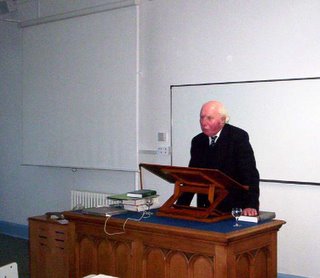
Yesterday was given over to a celebration of Prof. Wilson's 90th birthday as reported by Jim Davila in Paleojudaica (from whom I have appropriated this picture). It was through Prof. Wilson that I became interested in Gnosticism and it was thanks to him that I ended up studying with George Macrae at Harvard.
We last met in 2000 at the SNTS meeting in Durham (see below). Perhaps my favorite memory of him was from an academic meeting in Rome in 1974. He kindly took me under his wing as it was my first visit to "the eternal city." One afternoon, his hearing aid failed as we set out on a guided tour of the catacombs. He simply turned it off and enjoyed the tour with the rest of the group.

Here's to you, Robin! Lang may your lum reek!
Friday, February 17, 2006
Rationale for blessing civil partnerships
Here's a letter written by the Dean of Emmanuel College Cambridge, the Rev. Jeremy Caddick about the college's position on blessing civil partnerships. Its been written about in the Guardian.
Text of letter from the Dean of Emmanuel College Cambridge The Revd Jeremy Caddick
6th February 2006
The Rt Revd Dr Anthony Russell
Bishop of Ely
Civil Partnerships
The Chapel Committee here recently met and considered, among other things, what should be the response to requests for services following the registering of Civil Partnerships. The Committee looked at the House of Bishops’ Pastoral Statement issued last July.
I am conscious that the Colleges do not see themselves as falling within the formal jurisdiction of the Diocese of Ely, but I thought it important to write to you as the nearest member of the House of Bishops to tell you about the outcome of those discussions, and also to put on record my own dismay at the damage that is being done to the Church’s standing by the handling of this question. I am aware that your ear will also be being bent by those who take a very different view from my own!
The advice of members of the Chapel Committee and of the College Council, who also considered the matter, was that we would not wish to close the door to having services for members of the College community who requested them. They left it to the Dean to judge what form of service would be appropriate. (I recognise that there will be complex issues to be talked through in relation to each request that is received. None have been so far.)
The House of Bishops statement came in for considerable criticism. In particular people were not convinced by the distinction between not offering a blessing on one hand and encouraging clergy to respond sensitively to requests for services of prayer on the other.
In a community such as this one people know that there is considerable diversity in human sexual relationships, and, in general, see the importance of affirming and celebrating those that are faithful and life affirming. People look to college chapels as offering resources and support in doing that, and this is part of the ministry here that I continue to find rewarding and encouraging.
I appreciate the political considerations that propel the House of Bishops to begin the statement with quite such a vehement reaffirmation of the teaching that, “sexual intercourse, as an expression of faithful intimacy, properly belongs within marriage exclusively” (emphasis added). However such a starting point would seem to fly in the face of pastoral experience. To put it bluntly, what planet is the House of Bishops on? I cannot recall the last time I presided over the marriage of a couple who were not already sleeping together. I have no intention of turning such couples away and rather than taxing them on the subject of their sleeping arrangements, I find it much more productive to use this once in a lifetime opportunity to draw their attention to the grace-charged and God revealing aspects of the relationship that they are in the process of making.
I am concerned that in setting its face so publicly against gay relationships the Church imperils, perhaps terminally, its standing to speak authoritatively on the subject of relationships generally. There is no shortage of people who wish to portray the Church as reactionary and irrelevant. To be blunt again, I am dismayed that the House of Bishops statement plays into their hands.
Text of letter from the Dean of Emmanuel College Cambridge The Revd Jeremy Caddick
6th February 2006
The Rt Revd Dr Anthony Russell
Bishop of Ely
Civil Partnerships
The Chapel Committee here recently met and considered, among other things, what should be the response to requests for services following the registering of Civil Partnerships. The Committee looked at the House of Bishops’ Pastoral Statement issued last July.
I am conscious that the Colleges do not see themselves as falling within the formal jurisdiction of the Diocese of Ely, but I thought it important to write to you as the nearest member of the House of Bishops to tell you about the outcome of those discussions, and also to put on record my own dismay at the damage that is being done to the Church’s standing by the handling of this question. I am aware that your ear will also be being bent by those who take a very different view from my own!
The advice of members of the Chapel Committee and of the College Council, who also considered the matter, was that we would not wish to close the door to having services for members of the College community who requested them. They left it to the Dean to judge what form of service would be appropriate. (I recognise that there will be complex issues to be talked through in relation to each request that is received. None have been so far.)
The House of Bishops statement came in for considerable criticism. In particular people were not convinced by the distinction between not offering a blessing on one hand and encouraging clergy to respond sensitively to requests for services of prayer on the other.
In a community such as this one people know that there is considerable diversity in human sexual relationships, and, in general, see the importance of affirming and celebrating those that are faithful and life affirming. People look to college chapels as offering resources and support in doing that, and this is part of the ministry here that I continue to find rewarding and encouraging.
I appreciate the political considerations that propel the House of Bishops to begin the statement with quite such a vehement reaffirmation of the teaching that, “sexual intercourse, as an expression of faithful intimacy, properly belongs within marriage exclusively” (emphasis added). However such a starting point would seem to fly in the face of pastoral experience. To put it bluntly, what planet is the House of Bishops on? I cannot recall the last time I presided over the marriage of a couple who were not already sleeping together. I have no intention of turning such couples away and rather than taxing them on the subject of their sleeping arrangements, I find it much more productive to use this once in a lifetime opportunity to draw their attention to the grace-charged and God revealing aspects of the relationship that they are in the process of making.
I am concerned that in setting its face so publicly against gay relationships the Church imperils, perhaps terminally, its standing to speak authoritatively on the subject of relationships generally. There is no shortage of people who wish to portray the Church as reactionary and irrelevant. To be blunt again, I am dismayed that the House of Bishops statement plays into their hands.
Tuesday, February 07, 2006
What Are They Saying About Jesus?
A talk I gave for the Church Club of NYC on Jan 30th at Church of the Ascension can be accessed here. The link has links to an mp3 file and a PowerPoint Presentation (alas without graphics --lost in the conversion to Adobe) so with a bit of finessing, you can link the sound file to the PPT. Enjoy!
Monday, January 23, 2006
World Mission Sunday, Epiphany, 2006
Here are some homiletical reflections for the last Sunday of Epiphany, Feb 26th 2006 for the Office of Anglican and Global Relations of the Episcopal Church.
Sunday, January 22, 2006
My niece Joscelyn
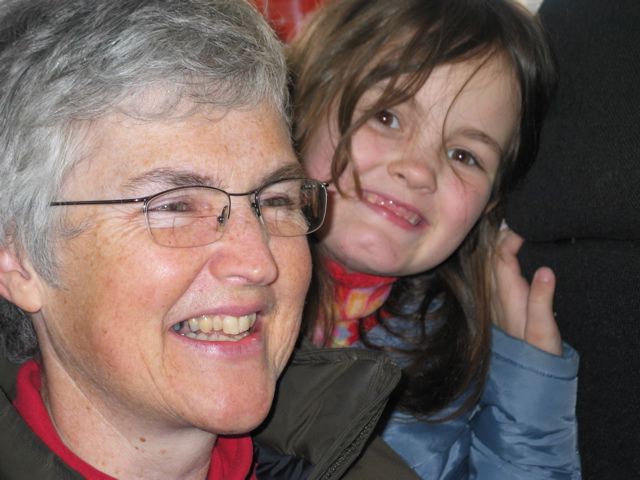
is going to be seven on January 30th 2006. Here's a picture of her taken by my partner Julian on Dec 22nd, 2005 on a Duck Tour with her parents and my parents in London. Duck Tours operate in several cities in the US with rivers as well as in London. By means of an amphibious vehicle, tourists are taken on a guided city tour on land and sea.
Subscribe to:
Comments (Atom)
The Oxford Handbook of the Book of Common Prayer Edited by Ruth A. Meyers, Luiz Carlos Teixeira Coelho, and Paul F. Bradshaw Oxford Handbo...

-
 https://www.churchpublishing.org/planningforritesandritualsyeara The indispensable guide to curating resources for worship in the Episcopal ...
 -
Just thrilled that our podcast conversations with contributors to Borderlands of Theological Education are available here: https://podcast...