Saturday, February 25, 2006

Our Household


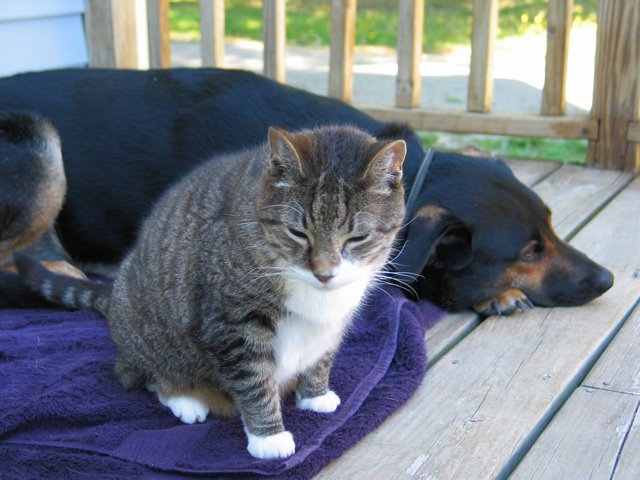
is more often than not rather furry. We live in seminary housing in the middle of Chelsea with our two dogs Diamond and Reuben, and our two cats Fishy and Mouflon. Reuben and Fishy get on well (as you see) but alas, the same cannot be said of Mouflon and Fish. Mouflon seems to think of himself as something other than a cat (a dog perhaps?) and prefers to relate to people.

Living in a household wherein only two occupants communicate by words makes one pay attention to NVC: canine gestures, movements, expressions; feline presence and sounds (Fishy is part siamese) all play a part of daily routine. Laura Hillenbrand describes Tom Smith, Seabiscuit's trainer: "Perhaps Smith spoke so infrequently because he was listening so hard. Horses speak with the smallest of motions; Smith saw and heard everything." When the grooms walked horses round in circles to cool them down, they'd see him "squatting on the floor turning the horses over in his mind." "He lived by a single maxim: Learn your horse. Each one is an individual, and once you penetrate his mind and heart, you can often work wonders with an otherwise intractable beast."

We got Reuben as an eight week old puppy. He was off leash on 10th Avenue following an older dog and a young man. Julian said to the young man, "If you love your dog, you'll keep him on a leash as 10th Avenue is very busy." When the young man announced that he wanted not to keep but to sell him, Julian said, "Done!" Reuben arrived in our house after a quick checkup at the local vet, and the first thing he did was rush to hide behind Angus, our old shepherd, who was lying down. Angus, being rather old and mellow, offered Reuben the puppy a safe warm vantage point from which to take in the lay of our apartment. Negotiating Diamond, our female shepherd (who is rather tempramental due to her unstable upbringing before we got her) and with whom he grew up as a sister/mother substitute, is one of Reuben's skills.

Wednesday, February 22, 2006

Whatever happened to imagination?

In an effort to revive sagging fortunes and declining attendance at Colonial Williamsburg, organizers at the Colonial Williamsburg Foundation have affianced themselves to an organization called "Revolutionary City" (Virginia Pilot, Feb 21st). Starting in March, parts of the town will be closed to tourists unless they pay extra admission fees. Behind the gates, "Revolutionary City" will recreate events during the American revolution between 1776-1783 in which "George Washington" will address the troops before the march to Yorktown, for example. Fee paying guests may ask a soldier what he thinks of his leader (Newsweek, Feb 13th).

Apparently, museum administrators opine that people today have a harder time connecting their own lives with living history sites like Williamsburg. They feel that recreations of distant events with live actors will help today's multicultural audiences do just that.

The Virginia Pilot article reports that in the mid-eighties 1.2 million paying visitors a year kept local restaurant and hotels busy. When I visited in 1976, it was thriving. I enjoyed every minute of my visit. So what happened to imagination? I don't know about you, but once I see a recreation of an event or a book as a movie, its likely that images from the movie replace what I once imagined as the battle of Culloden and the defeat of Bonnie Prince Charlie, or a tea farm in Kenya where Karen Blixen once lived at the foot of the Ngong hills (about which I know a tiny bit having grown up near Kisumu). Imagination not only liberates our minds and hearts but it creates possibility and vision. It is polyvalent and not uniform: no images need be set in stone.

Recently I revisited the Walters Art Gallery in Baltimore. My acoustiguide allowed me to access three kinds of information: descriptions of art works, assessments of the religious significance of various pieces and short pieces of music thought relevant to the piece. With imagination and emotions kindled, I can still see and hear a painting and accompanying music from that visit. If my critical imagination abandoned painting descriptions or thought another piece of music more suitable to a painting or sculpture, so much the better.

I've been to Gettysburg. The field where Pickett's charge took place and the setting for President Lincoln's Gettysburg address live in my imagination aided by a few photographs of the time. I am alas, sceptical that recreating events from the period of the American revolution will heighten my engagement with the period. I'm glad I went to Williamsburg a long time ago.

Sunday, February 19, 2006

Professor R. McL. Wilson's 90th Birthday

Thirty years ago when I was an undergraduate at St. Mary's College, St. Andrews University in Scotland, Professors Ernest Best, Matthew Black and Robin McL. Wilson ran the NT department. My father took me to visit before I was accepted and anxiously inquired of Principal Black whether it was likely that I might marry a presbyterian. "Oh, there are many different groups represented here" was the reply.

Prof. Wilson once told us at St. Mary's a wonderful story about material being prepared for a two volume work on NT Apocrypha and Pseudepigrapha he translated into English. Some of the material was given to a typist who happened to be a friend of Prof. Nisbet's daughter. Prof. Nisbet recounted that his daughter came to him wondering (on behalf of her friend) about Prof. Wilson's interest in ghosties. "Oh, its not ghosties Prof. Wilson is interested in," he replied, "Its Gnostics."

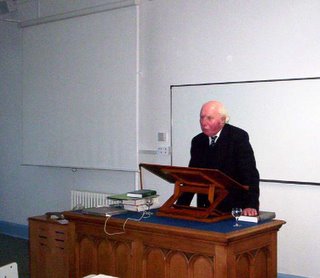
Yesterday was given over to a celebration of Prof. Wilson's 90th birthday as reported by Jim Davila in Paleojudaica (from whom I have appropriated this picture). It was through Prof. Wilson that I became interested in Gnosticism and it was thanks to him that I ended up studying with George Macrae at Harvard.

We last met in 2000 at the SNTS meeting in Durham (see below). Perhaps my favorite memory of him was from an academic meeting in Rome in 1974. He kindly took me under his wing as it was my first visit to "the eternal city." One afternoon, his hearing aid failed as we set out on a guided tour of the catacombs. He simply turned it off and enjoyed the tour with the rest of the group.

Here's to you, Robin! Lang may your lum reek!

Friday, February 17, 2006

Rationale for blessing civil partnerships

Here's a letter written by the Dean of Emmanuel College Cambridge, the Rev. Jeremy Caddick about the college's position on blessing civil partnerships. Its been written about in the Guardian.

Text of letter from the Dean of Emmanuel College Cambridge The Revd Jeremy Caddick

6th February 2006
The Rt Revd Dr Anthony Russell
Bishop of Ely

Civil Partnerships

The Chapel Committee here recently met and considered, among other things, what should be the response to requests for services following the registering of Civil Partnerships. The Committee looked at the House of Bishops’ Pastoral Statement issued last July.

I am conscious that the Colleges do not see themselves as falling within the formal jurisdiction of the Diocese of Ely, but I thought it important to write to you as the nearest member of the House of Bishops to tell you about the outcome of those discussions, and also to put on record my own dismay at the damage that is being done to the Church’s standing by the handling of this question. I am aware that your ear will also be being bent by those who take a very different view from my own!

The advice of members of the Chapel Committee and of the College Council, who also considered the matter, was that we would not wish to close the door to having services for members of the College community who requested them. They left it to the Dean to judge what form of service would be appropriate. (I recognise that there will be complex issues to be talked through in relation to each request that is received. None have been so far.)

The House of Bishops statement came in for considerable criticism. In particular people were not convinced by the distinction between not offering a blessing on one hand and encouraging clergy to respond sensitively to requests for services of prayer on the other.

In a community such as this one people know that there is considerable diversity in human sexual relationships, and, in general, see the importance of affirming and celebrating those that are faithful and life affirming. People look to college chapels as offering resources and support in doing that, and this is part of the ministry here that I continue to find rewarding and encouraging.

I appreciate the political considerations that propel the House of Bishops to begin the statement with quite such a vehement reaffirmation of the teaching that, “sexual intercourse, as an expression of faithful intimacy, properly belongs within marriage exclusively” (emphasis added). However such a starting point would seem to fly in the face of pastoral experience. To put it bluntly, what planet is the House of Bishops on? I cannot recall the last time I presided over the marriage of a couple who were not already sleeping together. I have no intention of turning such couples away and rather than taxing them on the subject of their sleeping arrangements, I find it much more productive to use this once in a lifetime opportunity to draw their attention to the grace-charged and God revealing aspects of the relationship that they are in the process of making.

I am concerned that in setting its face so publicly against gay relationships the Church imperils, perhaps terminally, its standing to speak authoritatively on the subject of relationships generally. There is no shortage of people who wish to portray the Church as reactionary and irrelevant. To be blunt again, I am dismayed that the House of Bishops statement plays into their hands.

Tuesday, February 07, 2006

What Are They Saying About Jesus?

A talk I gave for the Church Club of NYC on Jan 30th at Church of the Ascension can be accessed here. The link has links to an mp3 file and a PowerPoint Presentation (alas without graphics --lost in the conversion to Adobe) so with a bit of finessing, you can link the sound file to the PPT. Enjoy!

Monday, January 23, 2006

World Mission Sunday, Epiphany, 2006

Here are some homiletical reflections for the last Sunday of Epiphany, Feb 26th 2006 for the Office of Anglican and Global Relations of the Episcopal Church.

Sunday, January 22, 2006

My niece Joscelyn


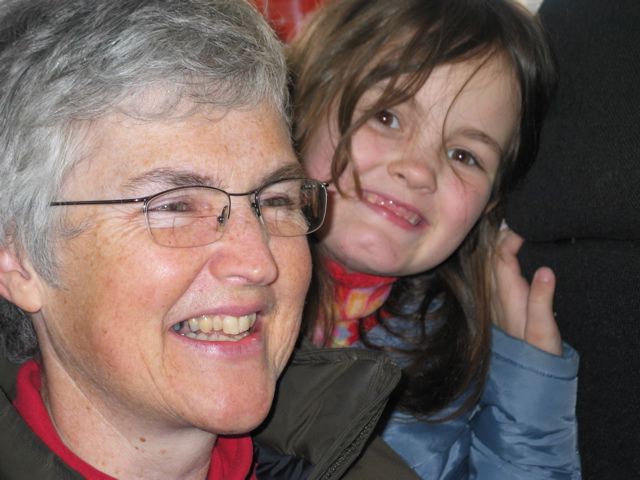
is going to be seven on January 30th 2006. Here's a picture of her taken by my partner Julian on Dec 22nd, 2005 on a Duck Tour with her parents and my parents in London. Duck Tours operate in several cities in the US with rivers as well as in London. By means of an amphibious vehicle, tourists are taken on a guided city tour on land and sea.

Narnia: Christian Triumphalism or Imaginative Pluralism?

Narnia: Christian Triumphalism or Imaginative Pluralism?


The recently released movie Narnia offers its own interpretation of a book I enjoyed as a child, The Lion, the Witch and the Wardrobe by C. S. Lewis. For many, the appeal of the movie will be because it is Christian. But for me its appeal lies in the way a Christian author takes another reality seriously by asking what redemption might look like in that other context.

The book is set in post-war Britain. A cup of tea is the elixir of life. Fathers are absent because they’ve gone off to war or killed. Separation from parents is normal and brings about closer sibling relations. The movie opens with the bombing of Britain and closes with the battle between the armies of the White Witch and Aslan in which gryphon-like creatures drop large rocks on the enemy. The Pevensie children, forced to hide in the middle of the night from German bombs, will in the end fight and win against the enemy with the weapons of children: swords, bows and arrows. Both worlds center on children, particularly boys. Battling the enemy is the way Peter becomes a man. Aslan tells Peter never to forget to wipe his sword. But “Battles are ugly when women fight” says Father Christmas to Lucy. In the movie, Lucy’s friendship with the faun Tumnus is the only real relationship. C. S. Lewis lost his mother to cancer at the age of eight. Since his father was consumed by grief, he and his brother Warren (Warnie) grew up together in a world of their own.

There are some other strange features of characters in the movie and the book. Aslan is not a human. He is not a divinity who has become flesh. Thus, he has no intrinsic connection to the children. He is neither a father nor a brother; he is present to them one moment and absent from them the next. Their “conversion” from fear of him to affection and loyalty is on the level of sensation: “his voice was deep and rich and somehow took the fidgets out of them.” The White Witch, however, looks human. Ann Peacock, the movie’s screenwriter, emphasizes the White Witch’s maternal sentiments when she first meets Edmund. “I have no children of my own,” she says as she wraps her fur around him, feeding him with Turkish Delight and notions that he might succeed her. To be sure, in C. S. Lewis’ book the White Witch utters these same words, but to Edmund abject at her feet, not nestled next to her in the sledge. In the movie, sitting next to him, the White Queen caresses Edmund’s face. Next time they meet he will lie in shackles at her feet imprisoned in her castle in order to lure his siblings to her but their first encounter is all cuddles and maternal care. Father Christmas appears in a world where there is no Christmas simply to hand out presents and (in the book) a tea-tray with hot tea for the children and beavers.

It is not surprising that there are these anomalous features of the Christianity of Narnia. C. S. Lewis wrote The Lion, the Witch and the Wardrobe to ask “Suppose there were a world like Narnia and it needed rescuing and the Son of God (or the “Great Emperor oversea”) went to redeem it, as He came to redeem ours, what might it, in that world, have been like?” (8 June 1960, Letter to Patricia). Viewers of Narnia and readers are invited into the same imaginative exercise not just in imaginary worlds but also in our world.

Aslan’s breath re-creates Narnia and restores the dead to life. What involvement in a world does the creation of (or giving birth to) a world imply? What might the creative and redemptive roles of animals in our world or other worlds be? Lucy finds the way to Narnia first. Are there other prophetic roles children and women play in our world or other worlds? In Narnia, the betrayal and treachery of siblings is the greatest sin. However, Edmund repents and is forgiven. This is not the same thing as the betrayal of Jesus by Judas. For one thing, Edmund is a child. In other religions and other worlds there may be different and greater sins. In Narnia, the world is in thrall to winter of the White Witch. What if the world were not viewed as “enemy-occupied territory?" While Lewis might be thought to articulate the worst of Christian triumphalism and exclusivity, if one takes his explanation of what he intended to do in The Lion, The Witch and the Wardrobe seriously, consideration of how the triumph of love might work in our world and other worlds to defeat evil in fact respects diversity and religious pluralism.

On Not Being A Sausage

The name of my blog (should it be 'blog as an abbreviation of "weblog"?) derives from The Teachings of Silvanus, a noncanonical early Christian wisdom text found in the Nag Hammadi Library but alas without numbers.

A teacher admonishes an initiate:-

Do not be a sausage which is full of useless things.

Seems like a good motto for a new blog at the beginning of 2006.

The entire text is easy to read and full of practical advice about the means whereby one can "return to your First Father God and Wisdom your Mother." It also contains wisdom Christology some of which derives from the Wisdom of Solomon and some from the type of wisdom hymn that emerges in Philippians 2.

An excellent example of the vitality of wisdom traditions in Christianity after the time of the New Testament and outside the canon!

  The Oxford Handbook of the Book of Common Prayer Edited by Ruth A. Meyers, Luiz Carlos Teixeira Coelho, and Paul F. Bradshaw Oxford Handbo...